Pronouns for Kids
Have you ever noticed that we don’t always repeat someone’s name when we speak or write?
For example:
Riya is my friend. Riya loves drawing. Riya draws every day.
This sounds repetitive.
We can make it much better:
Riya is my friend. She loves drawing. She draws every day.
The word she takes the place of the noun Riya. This is called a pronoun.
In simple words, a pronoun is a word used in place of a noun.
Pronouns make our sentences shorter, smoother, and easier to understand. They are an important part of English grammar and are among the first grammar concepts children learn after nouns.
In this guide, we’ll learn
what pronouns are, the different types of pronouns, pronoun examples, easy grammar rules, common mistakes, and fun ways to help children learn them.
What Is a Pronoun?
A pronoun is a word that takes the place of a noun.
Instead of repeating the same noun several times, we can use a pronoun.
Example
Aarav is a good student. Aarav studies every day. Aarav likes mathematics.
This sentence repeats “Aarav” too many times.
We can write:
Aarav is a good student. He studies every day. He likes mathematics.
Here, he is a pronoun because it takes the place of Aarav.
More examples
- Meena is singing. She has a beautiful voice.
- The dog is hungry. It wants food.
- Rahul and I are friends. We play together.
- The children are outside. They are playing.
The words she, it, we, and they are pronouns.
Why Do We Use Pronouns?
Pronouns help us avoid repeating the same nouns again and again.
Compare these two examples:
Without pronouns
Neha went to the park. Neha met Neha’s friend. Neha and Neha’s friend played with a ball.
That sounds awkward.
With pronouns
Neha went to the park. She met her friend. They played with a ball.
The second version sounds much more natural.
Pronouns help children:
- avoid repetition
- make sentences shorter
- improve writing
- speak more naturally
- connect ideas
- understand stories and reading passages
Types of Pronouns
There are several types of pronouns in English grammar.
The main types children commonly learn are:
- Personal Pronouns
- Possessive Pronouns
- Reflexive Pronouns
- Demonstrative Pronouns
- Interrogative Pronouns
- Relative Pronouns
- Indefinite Pronouns
- Reciprocal Pronouns
Let’s understand each type with simple examples.
 1. Personal Pronouns
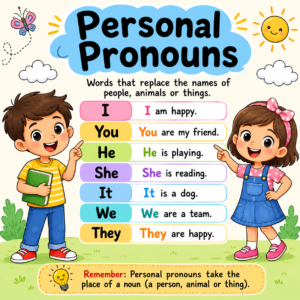
Personal pronouns are used to refer to people, animals, or things.
The most common personal pronouns are:
I, you, he, she, it, we, and they
Examples
- I like mangoes.
- You are my friend.
- He is playing cricket.
- She is reading a book.
- It is raining.
- We are going to school.
- They are watching a movie.
Personal pronouns can refer to one person or thing or to more than one.
Singular personal pronouns
- I
- you
- he
- she
- it
Plural personal pronouns
- we
- you
- they
Remember that you can be used for one person or more than one person.
Subject and Object Pronouns
Personal pronouns can also be divided into subject pronouns and object pronouns.
Subject pronouns
Subject pronouns usually tell us who is doing the action.
They are:
I, you, he, she, it, we, they
Examples:
- I eat breakfast.
- She sings well.
- They play football.
Object pronouns
Object pronouns usually tell us who or what receives the action.
They include:
me, you, him, her, it, us, them
Examples:
- Mom called me.
- I saw him at school.
- The teacher helped her.
- Dad took us to the park.
- We invited them to the party.
Easy comparison
| Subject Pronoun | Object Pronoun |
|---|---|
| I | me |
| you | you |
| he | him |
| she | her |
| it | it |
| we | us |
| they | them |
 2. Possessive Pronouns
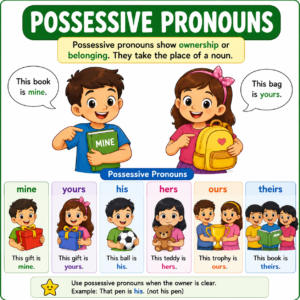
Possessive pronouns show ownership or belonging.
They tell us that something belongs to someone.
Common possessive pronouns include:
mine, yours, his, hers, ours, theirs
Examples
- This pencil is mine.
- That bag is yours.
- The blue bicycle is his.
- The red dress is hers.
- This classroom is ours.
- Those books are theirs.
Compare
This is my book.
Here, my comes before the noun “book.”
This book is mine.
Here, mine stands on its own.
This is an important distinction for children to learn.
Also Read: 50 Common Phrasal Verbs with Meanings and Examples
 3. Reflexive Pronouns
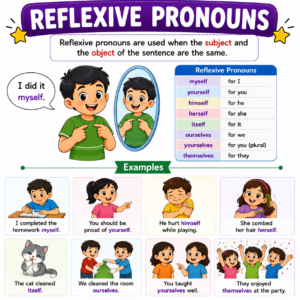
Reflexive pronouns are used when the subject and the object of a sentence refer to the same person or thing.
Common reflexive pronouns include:
- myself
- yourself
- himself
- herself
- itself
- ourselves
- yourselves
- themselves
Examples
- I made the cake myself.
- She taught herself to draw.
- He hurt himself while playing.
- We cleaned the room ourselves.
- They enjoyed themselves at the party.
- The cat cleaned itself.
Easy way to remember
Many reflexive pronouns end in:
-self or -selves
myself, yourself, himself, herself, itself
ourselves, yourselves, themselves
 4. Demonstrative Pronouns
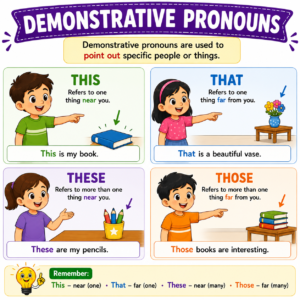
Demonstrative pronouns are used to point to particular people or things.
The four main demonstrative pronouns are:
this, that, these, those
Examples
This is my book.
That is your bicycle.
These are my shoes.
Those are beautiful flowers.
Easy rule
This → one thing that is near
That → one thing that is farther away
These → more than one thing that is near
Those → more than one thing that is farther away
Example
Imagine you are holding one pencil:
This is my pencil.
Now imagine you see several pencils on a table far away:
Those are my pencils.
 5. Interrogative Pronouns
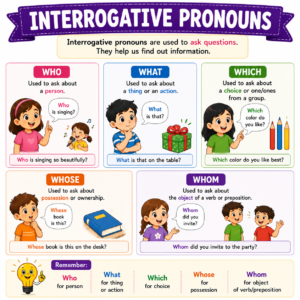
Interrogative pronouns are used to ask questions.
Common interrogative pronouns include:
- who
- whom
- whose
- what
- which
Examples
Who is at the door?
What is your name?
Which is your favourite colour?
Whose pencil is this?
For young children, who, what, which, and whose are the most commonly used forms.
 6. Relative Pronouns
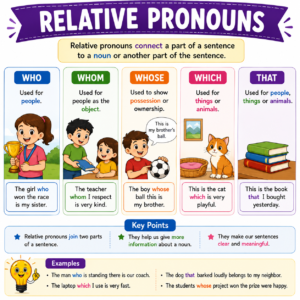
Relative pronouns connect a part of a sentence to a noun or another part of the sentence.
Common relative pronouns include:
- who
- whom
- whose
- which
- that
Examples
The girl who won the race is my sister.
This is the book that I bought yesterday.
The dog that barked loudly belongs to my neighbour.
The teacher who helped me was very kind.
Relative pronouns can seem difficult at first, so children should learn them through simple sentences rather than memorizing complicated rules.
 7. Indefinite Pronouns
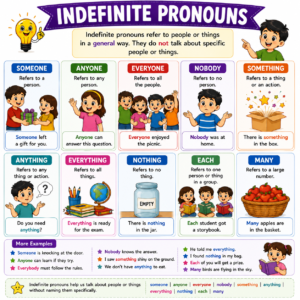
Indefinite pronouns refer to people or things without saying exactly who or what they are.
Examples include:
- someone
- somebody
- anyone
- everybody
- nobody
- something
- anything
- everything
- nothing
- each
- many
- few
- several
Examples
Someone left a bag here.
Everyone enjoyed the game.
Nobody knew the answer.
Something is inside the box.
Many were invited to the party.
These pronouns are useful when we don’t know or don’t need to mention a specific person or thing.
 8. Reciprocal Pronouns
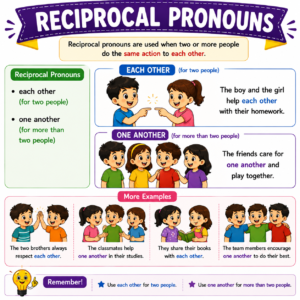
Reciprocal pronouns describe actions or feelings that go in both directions between people.
The two main reciprocal pronouns are:
each other and one another
Examples
- The two friends helped each other.
- The children shared their toys with one another.
- The sisters smiled at each other.
The idea is simple: one person does something to another person, and the action is returned.
Pronoun Examples in Sentences
Let’s identify the pronouns in these sentences.
1. She is reading a story.
Pronoun: She
2. They went to the playground.
Pronoun: They
3. This is my pencil.
Pronouns: This, my
4. The red bag is mine.
Pronoun: mine
5. He made the sandwich himself.
Pronouns: He, himself
6. Who is your teacher?
Pronoun: Who, your
7. Everyone enjoyed the show.
Pronoun: Everyone
8. The boys helped each other.
Pronoun: each other
Pronoun and Noun: What’s the Difference?
Children sometimes confuse nouns and pronouns because both can refer to people, places, animals, or things.
The difference is simple.
A noun names someone or something.
A pronoun takes the place of a noun.
Example
Rohan is playing football.
“Rohan” is a noun.
He is playing football.
“He” is a pronoun replacing “Rohan.”
Another example
The dog is sleeping.
“Dog” is a noun.
It is sleeping.
“It” is a pronoun.
How to Choose the Correct Pronoun
Choosing the right pronoun depends on who or what the pronoun refers to.
One boy
Aarav is happy. He is smiling.
One girl
Ananya is happy. She is smiling.
More than one person
Aarav and Ananya are happy. They are smiling.
One thing or animal
The puppy is hungry. It is eating.
The speaker
I am ready.
The speaker and another person
We are ready.
Pronoun-Antecedent Agreement
This may sound like a difficult grammar term, but the idea is simple.
A pronoun should agree with the noun it refers to in number and person.
The noun that a pronoun refers to is sometimes called its antecedent.
Correct
Riya lost her pencil.
Riya = one girl
her = singular pronoun
Correct
The boys lost their pencils.
boys = plural
their = plural
Incorrect
The boys lost his pencils.
The noun “boys” is plural, but “his” is singular.
Corrected
The boys lost their pencils.
This is an important rule for clear English writing.
Common Pronoun Mistakes
Mistake 1: Repeating the noun too much
Incorrect:
Rahul went to Rahul’s room because Rahul wanted Rahul’s book.
Better:
Rahul went to his room because he wanted his book.
Mistake 2: Using “me” instead of “I”
Incorrect:
Me and Riya went to the park.
Better:
Riya and I went to the park.
Here, I is the subject of the sentence.
Mistake 3: Using “he” or “she” incorrectly
Incorrect:
My mother said he was tired.
Better:
My mother said she was tired.
The pronoun should match the person being referred to.
Mistake 4: Confusing “their” and “there”
These words sound similar but have different meanings.
Their shows possession.
Their house is beautiful.
There usually refers to a place.
The books are over there.
Mistake 5: Confusing “your” and “you’re”
Your shows possession.
Your bag is on the table.
You’re means you are.
You’re very kind.
Teaching children to recognize these differences will improve both their grammar and writing.
Easy Ways to Teach Pronouns to Kids
Children learn grammar better when they can see and use it in everyday situations.
Here are some simple pronoun activities for home or the classroom.
1. Name-to-Pronoun Game
Write names on cards:
- Riya
- Aarav
- Meena
- Rahul
Ask children to replace each name with a pronoun.
Riya → she
Aarav → he
Riya and Meena → they
2. Pronoun Hunt
Give children a short story or paragraph.
Ask them to circle all the pronouns they can find.
For example:
Sam went to the park. He saw his friend there. They played football together.
Children can find:
He, his, they
3. Look Around and Speak
Ask children to look around the room.
For example:
This is my pencil.
That is your chair.
These are my books.
Those are the teacher’s markers.
This is an easy way to practise demonstrative pronouns.
4. Replace the Noun
Give children sentences with repeated nouns.
Maya likes Maya’s bicycle because Maya rides Maya’s bicycle every day.
Ask children to improve the sentence.
Answer:
Maya likes her bicycle because she rides it every day.
This activity helps children understand why pronouns are useful.
Quick Pronoun Practice
Try these questions with your child or students.
A. Find the Pronouns
Identify the pronouns in each sentence.
- She is my best friend.
- They are playing in the garden.
- This is my favourite book.
- We went to the museum.
- He made the model himself.
- Everyone was excited.
- Who is calling you?
- The children helped each other.
Answers
- She
- They
- This, my
- We
- He, himself
- Everyone
- Who, you
- each other
B. Choose the Correct Pronoun
1. Riya is reading. ___ is sitting near the window.
a) He
b) She
c) They
Answer: She
2. Rahul and I are friends. ___ play together.
a) We
b) He
c) It
Answer: We
3. The dogs are hungry. ___ need food.
a) It
b) He
c) They
Answer: They
4. This is my bag. That one is ___.
a) mine
b) I
c) me
Answer: mine
5. The two sisters helped ___.
a) themselves
b) each other
c) it
Answer: each other
Pronoun Chart for Kids
| Type of Pronoun | Examples |
|---|---|
| Personal | I, you, he, she, it, we, they |
| Possessive | mine, yours, his, hers, ours, theirs |
| Reflexive | myself, yourself, himself, herself, ourselves |
| Demonstrative | this, that, these, those |
| Interrogative | who, whom, whose, what, which |
| Relative | who, whom, whose, which, that |
| Indefinite | someone, anyone, everyone, nobody, something |
| Reciprocal | each other, one another |
Frequently Asked Questions About Pronouns
What is a pronoun in simple words?
A pronoun is a word that is used instead of a noun.
For example:
Riya is happy. She is smiling.
“She” is a pronoun that replaces “Riya.”
What are the most common pronouns?
Some common pronouns are:
I, you, he, she, it, we, they, me, him, her, us, and them.
What are the 8 types of pronouns?
The commonly taught types include:
- Personal pronouns
- Possessive pronouns
- Reflexive pronouns
- Demonstrative pronouns
- Interrogative pronouns
- Relative pronouns
- Indefinite pronouns
- Reciprocal pronouns
What is a personal pronoun?
A personal pronoun refers to a person, animal, or thing.
Examples include I, you, he, she, it, we, and they.
What is a possessive pronoun?
A possessive pronoun shows ownership or belonging.
Examples include mine, yours, his, hers, ours, and theirs.
What is a reflexive pronoun?
A reflexive pronoun refers back to the subject of a sentence.
Examples include myself, yourself, himself, herself, itself, ourselves, and themselves.
What is the easiest way to teach pronouns to children?
Start with simple examples from everyday life. Ask children to replace names with words such as he, she, it, we, and they. Games, short stories, and sentence-replacement activities can make learning pronouns easier and more memorable.
Final Takeaway
Pronouns may seem like small words, but they play a very important role in English grammar.
They help us avoid repeating nouns and make our sentences clearer, shorter, and more natural.
The easiest way for children to remember the basic idea is:
A pronoun is a word that takes the place of a noun.
Start with common personal pronouns such as I, you, he, she, it, we, and they. Once children are comfortable with these, introduce possessive, reflexive, demonstrative, interrogative, relative, indefinite, and reciprocal pronouns.
The best way to learn pronouns is not simply to memorize a list. Children should see pronouns in sentences, use them while speaking, find them while reading, and practise replacing nouns with the correct pronouns.
With regular practice, pronouns will quickly become a natural part of your child’s English.
Keep Learning English Grammar
Pronouns are closely connected to nouns and are an important foundation for learning more English grammar.
After learning pronouns, children can move on to verbs, adjectives, adverbs, prepositions, conjunctions, tenses, and sentence structure.
Explore more easy English grammar lessons on Krazy Smart Shop and help children build strong grammar skills step by step.