Nouns for Kids:
What is a noun?
If your child is learning English grammar, nouns are one of the first and most important concepts to understand. Nouns are the words we use to name people, places, animals, things, and even ideas. Simply put, a noun is a naming word.
For example:
- Riya is reading a book.
- The dog is sleeping.
- We visited Delhi.
- My teacher is kind.
- Happiness is important.
Riya, dog, Delhi, teacher, and happiness are all nouns because they name something.
Learning nouns helps children build better sentences, improve their vocabulary, and understand many other parts of English grammar.
In this guide, we’ll learn the different types of nouns, look at plenty of easy examples, and learn simple grammar rules that children can remember.
What Is a Noun?
A noun is a word that names a person, place, animal, thing, or idea.
Think of nouns as the names of the world around us.
Examples of nouns
| Category | Examples |
|---|---|
| Person | boy, teacher, doctor, mother |
| Place | school, park, India, Delhi |
| Animal | dog, elephant, tiger, butterfly |
| Thing | pencil, table, book, bicycle |
| Idea or feeling | happiness, honesty, courage, love |
Example sentence
The boy carried a blue bag to school.
There are three nouns in this sentence:
- boy — person
- bag — thing
- school — place
Why Are Nouns Important?
Nouns are everywhere in English.
Without nouns, it would be difficult to tell people what or whom we are talking about.
Compare these sentences:
She went there.
We don’t know who “she” is or where “there” is.
Now look at:
Ananya went to the library.
The sentence is much clearer because Ananya and library tell us exactly who and where.
Nouns help children:
- build meaningful sentences
- improve their vocabulary
- understand reading passages
- write better stories
- describe people and places
- communicate ideas clearly
That’s why learning nouns is an important step in learning English grammar.
Also Read: Power Guide to Prepositions: 100 Advanced Rules with Meaning, Use & Examples
Types of Nouns
There are several types of nouns in English grammar. The most common ones children learn are:
- Common Nouns
- Proper Nouns
- Concrete Nouns
- Abstract Nouns
- Collective Nouns
- Countable Nouns
- Uncountable Nouns
- Singular Nouns
- Plural Nouns
Let’s understand each type with simple examples.
 1. Common Nouns
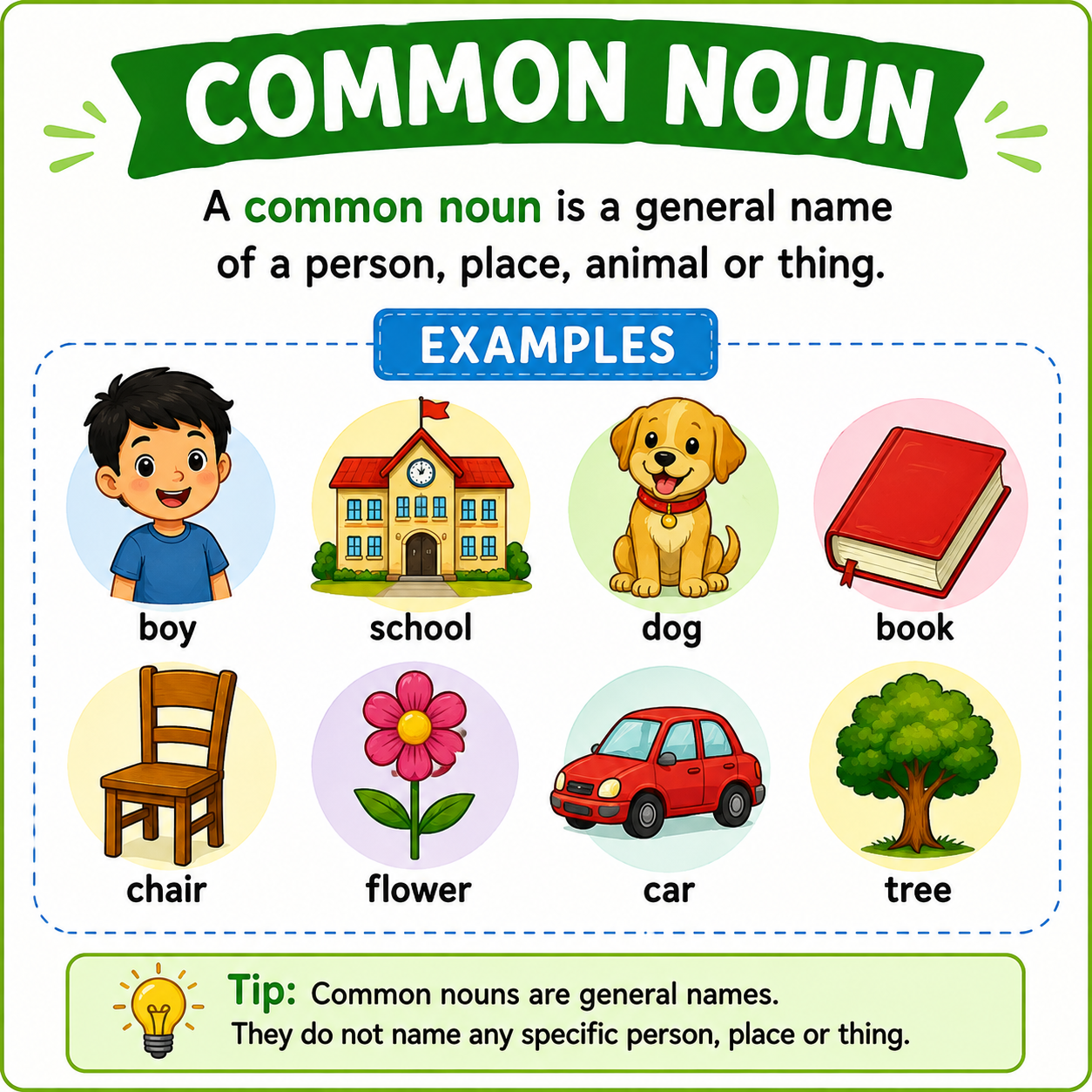
A common noun is a general name for a person, place, animal, or thing.
Common nouns do not name one particular person or thing.
Examples
- girl
- boy
- teacher
- city
- country
- school
- dog
- book
- river
- mountain
For example:
The girl is reading a book.
“Girl” and “book” are common nouns because they don’t tell us the specific name of the girl or book.
More examples
- teacher
- school
- car
- flower
- river
- animal
Easy trick
If the word gives you a general name, it is usually a common noun.
 2. Proper Nouns
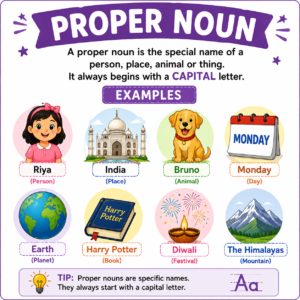
A proper noun is the special or specific name of a person, place, animal, organization, or thing.
Proper nouns always begin with a capital letter in English.
Examples
- Riya
- Rahul
- India
- Delhi
- Monday
- January
- The Himalayas
- The Ganges
Compare:
country → common noun
India → proper noun
city → common noun
Delhi → proper noun
girl → common noun
Riya → proper noun
Also Read: Power List: Prepositions Used After 100 Verbs and 100 Adjectives (With Examples)
Example
My friend Aarav lives in Mumbai.
Here:
- friend = common noun
- Aarav = proper noun
- Mumbai = proper noun
Remember
Common noun = general name
Proper noun = specific name
 3. Concrete Nouns
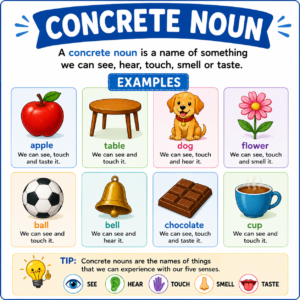
A concrete noun names something that we can experience through our five senses.
We can generally see, hear, smell, taste, or touch it.
Examples
- apple
- flower
- dog
- bell
- chocolate
- chair
- pencil
- music
For example:
The child ate an apple.
We can see, touch, smell, and taste an apple. Therefore, apple is a concrete noun.
More examples
The baby heard a bell.
“Bell” is a concrete noun.
The boy touched the table.
“Table” is a concrete noun.
 4. Abstract Nouns
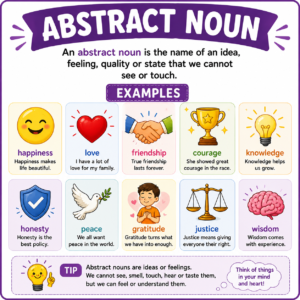
An abstract noun names something that we cannot usually see or touch.
It often refers to a:
- feeling
- quality
- idea
- emotion
- state
Examples
- happiness
- kindness
- honesty
- courage
- love
- friendship
- freedom
- anger
- wisdom
For example:
Kindness makes the world better.
We cannot physically touch kindness, but we can understand and experience it.
So kindness is an abstract noun.
Another example
The soldier showed great courage.
We cannot see or touch courage itself. It is a quality.
Therefore, courage is an abstract noun.
Easy trick
If you can experience an idea, feeling, or quality but cannot physically touch it, it may be an abstract noun.
 5. Collective Nouns
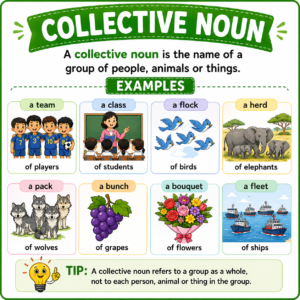
A collective noun names a group of people, animals, or things.
Instead of naming every member separately, we use one word for the whole group.
Examples
- a team of players
- a class of students
- a flock of birds
- a herd of elephants
- a pack of wolves
- a bunch of grapes
- a bouquet of flowers
- a fleet of ships
Example
A flock of birds flew across the sky.
“Flock” is a collective noun because it refers to a group of birds.
Another example
Our team won the match.
“Team” refers to a group of players.
 6. Countable Nouns
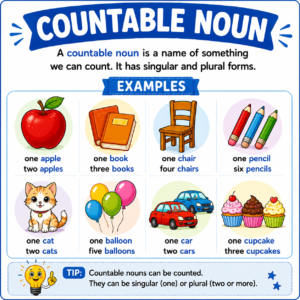
A countable noun is something that we can count.
We can usually use numbers with countable nouns.
Examples
- one apple, two apples
- one book, three books
- one pencil, five pencils
- one child, four children
- one chair, six chairs
We can say:
I have three books.
We can count the books, so books is a countable noun.
Countable nouns can be:
- singular: one book
- plural: two books
 7. Uncountable Nouns
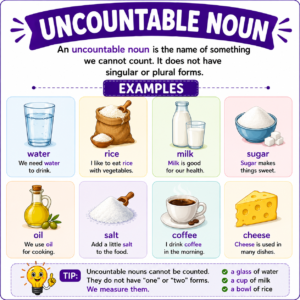
An uncountable noun refers to something that we don’t normally count as individual units.
Examples include:
- water
- milk
- rice
- sugar
- sand
- air
- information
- advice
We usually don’t say:
two waters
when we mean two amounts of water.
Instead, we can say:
two glasses of water
Similarly:
a bowl of rice
a spoonful of sugar
a piece of advice
Important grammar tip
Uncountable nouns generally don’t have a plural form when used in their ordinary meaning.
For example:
I need some information.
Not:
I need some informations.
 8. Singular Nouns
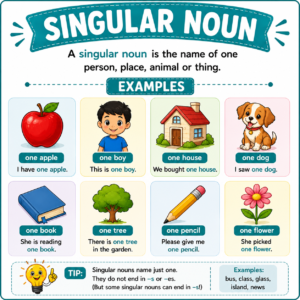
A singular noun refers to one person, animal, place, thing, or idea.
Examples
- boy
- girl
- cat
- book
- school
- apple
Example
The boy has a bicycle.
“Boy” and “bicycle” are singular nouns because there is only one of each.
 9. Plural Nouns
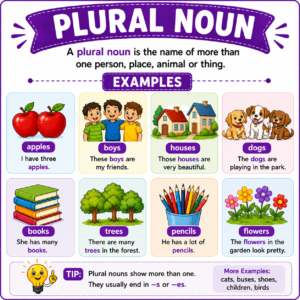
A plural noun refers to more than one person, animal, place, thing, or idea.
Examples
- boys
- girls
- cats
- books
- schools
- apples
Example
The boys are playing football.
“Boys” is plural because it refers to more than one boy.
Rules for Making Plural Nouns
Most children first learn to make plurals by adding -s.
Rule 1: Add -s
book → books
pen → pens
apple → apples
car → cars
Rule 2: Add -es
Some nouns ending in s, sh, ch, x, or z usually take -es.
bus → buses
dish → dishes
box → boxes
watch → watches
Rule 3: Change y to ies
When a noun ends in a consonant + y, the y usually changes to ies.
baby → babies
city → cities
story → stories
But when a noun ends in a vowel + y, we usually just add -s.
toy → toys
boy → boys
Rule 4: Some nouns change completely
Some nouns have irregular plural forms.
child → children
man → men
woman → women
foot → feet
tooth → teeth
mouse → mice
These forms need to be learned and remembered.
Common Noun vs Proper Noun
This is one of the most important differences children should understand.
| Common Noun | Proper Noun |
|---|---|
| girl | Riya |
| boy | Aarav |
| country | India |
| city | Delhi |
| river | Ganga |
| month | January |
| day | Monday |
| school | Delhi Public School |
Example
My friend lives in Delhi.
“friend” is a common noun.
“Delhi” is a proper noun.
Remember the capital letter
Proper nouns begin with capital letters:
India
Rohan
Monday
August
Not:
india
rohan
monday
august
Concrete Noun vs Abstract Noun
Here’s another easy comparison:
| Concrete Noun | Abstract Noun |
|---|---|
| apple | happiness |
| flower | beauty |
| book | knowledge |
| chair | comfort |
| dog | loyalty |
| cake | love |
A concrete noun refers to something we can experience with our senses.
An abstract noun refers to an idea, feeling, quality, or state.
Noun Examples in Sentences
Let’s identify the nouns in these sentences.
1. The dog chased the ball.
Nouns: dog, ball
2. Riya visited the museum.
Nouns: Riya, museum
3. The children played in the park.
Nouns: children, park
4. Honesty is a good quality.
Nouns: honesty, quality
5. A flock of birds crossed the river.
Nouns: flock, birds, river
6. My mother bought vegetables from the market.
Nouns: mother, vegetables, market
7. The teacher gave the students some advice.
Nouns: teacher, students, advice
Notice that a sentence can contain more than one noun.
How Can Children Find Nouns in a Sentence?
Here’s a simple three-step method.
Step 1: Look for naming words
Ask:
Who or what is being talked about?
Step 2: Look for people, places, animals and things
For example:
The cat is sleeping on the sofa.
Who?
cat
What?
sofa
Both are nouns.
Step 3: Look for ideas and feelings
Sometimes nouns aren’t things we can touch.
For example:
Courage is important.
“Courage” is a noun even though we can’t touch it.
Easy Noun Trick for Kids
Tell children to ask:
“Is this word naming someone or something?”
If yes, it may be a noun.
For example:
teacher → names a person
school → names a place
tiger → names an animal
pencil → names a thing
happiness → names a feeling or idea
All of these are nouns.
Common Mistakes Children Make with Nouns
Mistake 1: Forgetting capital letters
Incorrect:
my friend lives in india.
Correct:
My friend lives in India.
“India” is a proper noun and must begin with a capital letter.
Mistake 2: Using an incorrect plural
Incorrect:
two childs
Correct:
two children
“Child” has an irregular plural form.
Mistake 3: Making uncountable nouns plural
Incorrect:
I need some informations.
Correct:
I need some information.
Mistake 4: Confusing nouns with verbs
Some words can act as different parts of speech depending on how they are used.
For example:
I love chocolate.
Here, “love” is a verb.
Love is important.
Here, “love” is a noun.
This is why children should always look at how a word is being used in a sentence.
Fun Ways to Teach Nouns to Kids
Grammar doesn’t have to be boring.
Try these simple activities at home or in the classroom.
1. Noun Hunt
Ask children to look around the room and name ten nouns.
They might find:
- table
- chair
- pencil
- book
- bag
- window
- door
- clock
- bottle
- computer
2. Noun Sorting Game
Write words on small pieces of paper and ask children to sort them into:
Person | Place | Animal | Thing | Idea
3. Noun Scavenger Hunt
Give children five minutes to find:
- 3 people nouns
- 3 animal nouns
- 3 thing nouns
- 2 place nouns
4. Noun Story Challenge
Give children five nouns and ask them to create a short story using all five.
For example:
boy – forest – dog – treasure – map
This activity teaches nouns while also encouraging creativity and writing skills.
Quick Noun Practice
Try these questions.
A. Identify the nouns
- The cat is sitting on the chair.
- Rahul plays cricket.
- The children visited the zoo.
- Honesty is important.
- A herd of elephants crossed the road.
Answers
- cat, chair
- Rahul, cricket
- children, zoo
- honesty
- herd, elephants, road
B. Identify the Type of Noun
- India
- happiness
- team
- teacher
- apple
Answers
- India — Proper Noun
- happiness — Abstract Noun
- team — Collective Noun
- teacher — Common Noun
- apple — Concrete Noun
Remember that some nouns can belong to more than one category.
For example, apple can be both a common noun and a concrete noun.
Frequently Asked Questions About Nouns
What is a noun in simple words?
A noun is a naming word. It names a person, place, animal, thing, idea, feeling, or quality.
What are the 5 main types of nouns?
Children commonly learn these five types first:
- Common nouns
- Proper nouns
- Concrete nouns
- Abstract nouns
- Collective nouns
There are other useful classifications, including countable, uncountable, singular, and plural nouns.
What is a proper noun?
A proper noun is the specific name of a person, place, organization, day, month, or other particular thing. It begins with a capital letter.
Examples: Riya, India, Delhi, Monday, January.
What is an abstract noun?
An abstract noun names an idea, feeling, quality, or state that cannot usually be physically touched.
Examples: love, honesty, courage, happiness.
What is a collective noun?
A collective noun refers to a group of people, animals, or things.
Examples include team, class, flock, herd, and bunch.
Is “school” a noun?
Yes. School is a noun because it names a place or institution.
Is “happiness” a noun?
Yes. Happiness is an abstract noun because it names a feeling or state.
Final Takeaway
Nouns are one of the building blocks of English grammar. Once children understand nouns, it becomes easier for them to learn pronouns, verbs, adjectives, sentence structure, tenses, and many other grammar concepts.
The easiest way to remember a noun is:
A noun is a naming word.
Look for the names of people, places, animals, things, ideas, feelings, and qualities.
Start by helping children identify nouns in everyday sentences. Then gradually introduce common nouns, proper nouns, concrete nouns, abstract nouns, collective nouns, countable nouns, and uncountable nouns.
The more children read, speak, and write, the more naturally they will recognize and use nouns.
Keep Learning English Grammar
Nouns are only the beginning. Once your child understands nouns, the next step is learning pronouns, verbs, adjectives, adverbs, prepositions, conjunctions, and tenses.
Explore more simple English grammar lessons on Krazy Smart Shop and help children build strong grammar skills one concept at a time.
Suggested internal links:
- Pronouns for Kids: Types, Examples and Easy Ways to Learn Them
- Verbs for Kids: Types, Examples and Fun Ways to Learn
- Adjectives for Kids: Meaning, Types and Examples
- Prepositions for Kids: Meaning, Types and Examples
- English Tenses for Kids: A Simple Guide
- Punctuation Marks for Kids: Complete Guide with Examples