Verbs for Kids: What Are Verbs? Types, Examples and Fun Ways to Learn
What is a verb? If your child is learning English grammar, verbs are one of the most important grammar concepts to understand.
In simple words, a verb is a word that tells us about an action, a state, or something that happens.
Look at these sentences:
- The boy runs fast.
- Sarah reads a book.
- The baby sleeps peacefully.
- We are happy.
- They played football yesterday.
The words runs, reads, sleeps, are, and played are verbs.
Verbs help us know what someone or something does, what happens, or what something is like. Without verbs, most sentences would be incomplete.
In this easy guide, we’ll learn what verbs are, the different types of verbs, verb examples for kids, basic verb rules, common mistakes, and fun ways to practise verbs at home or in the classroom.
Also Read: Nouns for Kids: Types, Examples and Easy Grammar Rules
What Is a Verb?
A verb is a word that shows an action, state, or occurrence.
For young learners, the easiest definition is:
A verb is a doing word or a being word.
Examples of action verbs
- run
- jump
- eat
- swim
- write
- sing
- dance
- laugh
- play
- read
Examples in sentences
The dog runs.
Mia dances.
The children play.
In each sentence, the verb tells us what someone or something is doing.
But not all verbs show physical actions.
Consider:
I am happy.
She is tired.
They are students.
The verbs am, is, and are don’t show a physical action. They tell us about a state or condition.
Why Are Verbs Important?
Verbs are the heart of a sentence.
A sentence usually needs a verb to tell us what is happening.
Compare:
The boy.
This is not a complete thought.
Now:
The boy runs.
The verb runs tells us what the boy does.
Verbs help children:
- build complete sentences
- describe actions
- talk about events
- tell stories
- understand reading passages
- express time
- improve their writing
- communicate clearly
Learning verbs also prepares children for more advanced grammar concepts such as tenses, subject-verb agreement, helping verbs, and sentence structure.
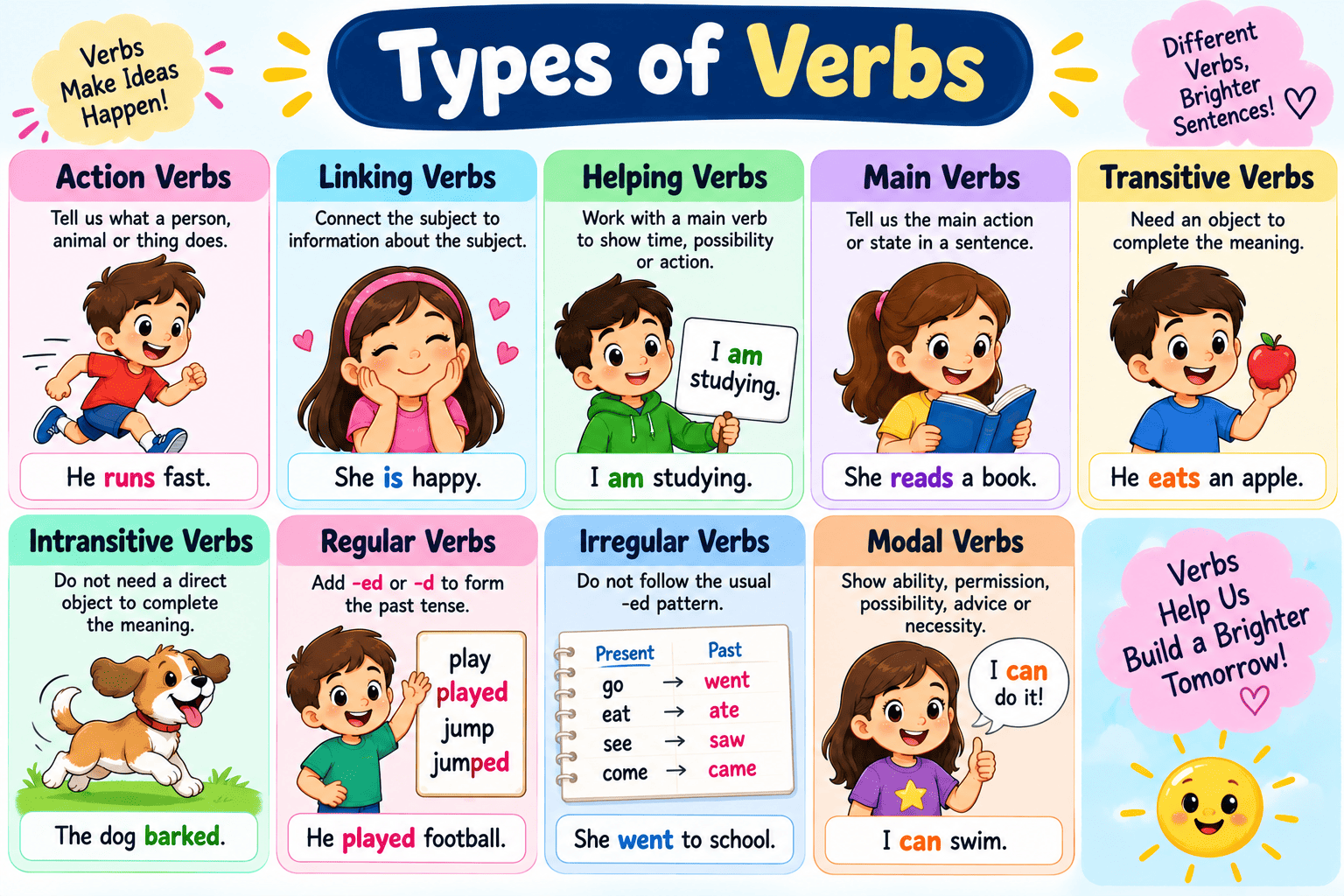
Types of Verbs for Kids
There are many ways to classify verbs in English grammar.
The most useful types for children include:
- Action Verbs
- Linking Verbs
- Helping Verbs
- Main Verbs
- Transitive Verbs
- Intransitive Verbs
- Regular Verbs
- Irregular Verbs
- Modal Verbs
Let’s understand them with simple examples.
 1. Action Verbs
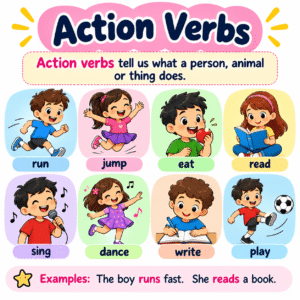
An action verb tells us what a person, animal, or thing does.
Action verbs are often the easiest verbs for children to identify.
Examples
- run
- jump
- walk
- eat
- drink
- write
- read
- sing
- dance
- swim
- kick
- laugh
Example sentences
The boy jumps over the puddle.
The girl reads a story.
The dog chased the ball.
The children laughed loudly.
The verbs jumps, reads, chased, and laughed describe actions.
Easy trick
Ask:
“What is the person, animal, or thing doing?”
The answer is often the action verb.
Also Read: 50 Common Phrasal Verbs with Meanings and Examples
 2. Linking Verbs
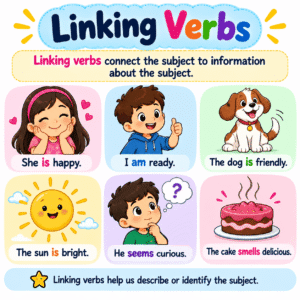
A linking verb connects the subject of a sentence to information about the subject.
Common linking verbs include forms of be:
- am
- is
- are
- was
- were
Other linking verbs can include:
- seem
- become
- feel
- look
- appear
- sound
- smell
- taste
Examples
Riya is happy.
The soup smells delicious.
The sky looks beautiful.
He became tired.
In these sentences, the verbs connect the subject with information that describes or identifies it.
Simple explanation for kids
A linking verb works like a bridge.
It connects:
Subject → Information about the subject
Example:
The flower → is → beautiful.
 3. Helping Verbs
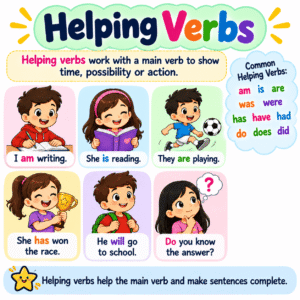
A helping verb works with a main verb to show things such as time, possibility, or whether an action is happening.
Common helping verbs include forms of:
be, have, and do
Examples:
- am
- is
- are
- was
- were
- has
- have
- had
- do
- does
- did
Examples
She is reading.
They are playing.
He has finished his homework.
Did you eat lunch?
In:
She is reading.
“is” helps the main verb “reading.”
More examples
- We are learning English.
- He has completed the project.
- They were playing outside.
- Did you finish your work?
 4. Main Verbs
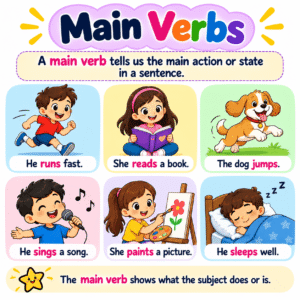
A main verb is the most important verb in a sentence because it tells us the main action or state.
Examples
The baby sleeps.
Main verb: sleeps
Rohan is running.
Main verb: running
She has finished her homework.
Main verb: finished
A sentence can have a helping verb and a main verb together.
Example
The children are singing.
- are = helping verb
- singing = main verb
 5. Transitive Verbs
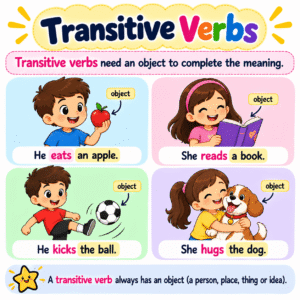
A transitive verb is a verb that usually needs an object to complete its meaning.
Example
Maya kicked the ball.
The verb is kicked.
What did Maya kick?
The ball.
“Ball” is the object of the verb.
More examples
Dad opened the door.
She read a book.
The boy ate an apple.
The verbs opened, read, and ate have objects.
Easy trick
Ask:
“What?” or “Whom?” after the verb.
If the answer gives you an object, the verb may be transitive.
 6. Intransitive Verbs
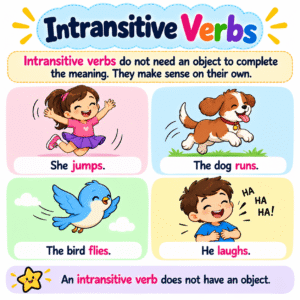
An intransitive verb does not need a direct object to complete its meaning.
Examples
The baby cried.
The birds flew.
The children laughed.
The dog barked.
The sentences are complete without a direct object.
For example:
The baby cried.
We don’t need to say what the baby cried.
Important note
Some verbs can be either transitive or intransitive depending on how they are used.
For example:
She opened the door.
“Opened” has an object: door.
The door opened.
Here, “opened” has no direct object.
Children don’t need to memorize this distinction immediately. It becomes easier through examples and practice.
 7. Regular Verbs
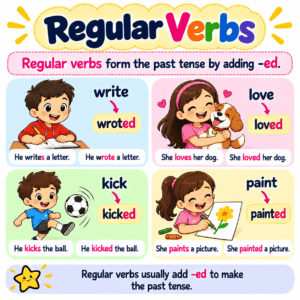
Regular verbs follow a common pattern when we change them into the past tense.
Usually, we add -ed or -d.
Examples
| Present | Past |
|---|---|
| walk | walked |
| jump | jumped |
| play | played |
| clean | cleaned |
| open | opened |
| smile | smiled |
Example
Present:
I walk to school.
Past:
I walked to school yesterday.
The verb follows the regular -ed pattern.
 8. Irregular Verbs
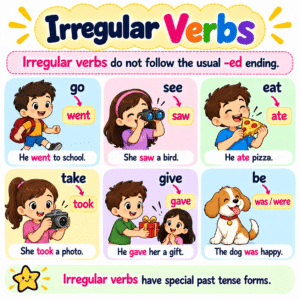
Irregular verbs do not follow the usual -ed pattern when they change into the past tense.
Children need to learn their different forms.
Examples
| Present | Past |
|---|---|
| go | went |
| eat | ate |
| see | saw |
| come | came |
| run | ran |
| take | took |
| write | wrote |
| drink | drank |
Example
I go to school every day.
I went to school yesterday.
We don’t say:
I goed to school yesterday.
The correct past form is went.
 9. Modal Verbs
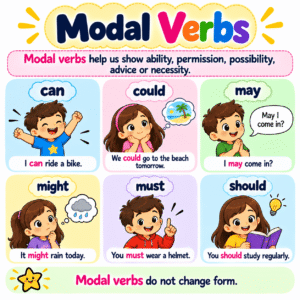
Modal verbs are helping verbs that express ideas such as ability, possibility, permission, advice, or necessity.
Common modal verbs include:
- can
- could
- may
- might
- must
- should
- will
- would
Examples
I can swim.
You should study.
We must follow the rules.
It might rain today.
May I come in?
Modal verbs are especially useful when children learn how to express different kinds of meaning.
Verb Tenses for Kids
Verbs can change to show when something happens.
The three basic time ideas are:
- Present
- Past
- Future
Present
Something happens now or regularly.
I play football.
Past
Something already happened.
I played football yesterday.
Future
Something will happen later.
I will play football tomorrow.
Understanding verbs is essential for learning English tenses.
Verb Forms
Children will often see different forms of the same verb.
For example:
play
- play
- plays
- played
- playing
Another example:
eat
- eat
- eats
- ate
- eating
The form changes depending on the subject and the tense.
Example
I play football.
She plays football.
They played football yesterday.
He is playing football now.
Learning these forms helps children write grammatically correct sentences.
Subject-Verb Agreement
One important verb rule is subject-verb agreement.
This means the verb should agree with the subject.
Examples
I play.
You play.
We play.
They play.
But:
He plays.
She plays.
It plays.
Notice that with he, she, and it in the simple present tense, we often add -s or -es to the verb.
More examples
The boy runs fast.
The boys run fast.
The dog barks loudly.
The dogs bark loudly.
This is an important grammar rule for young writers.
Verb Examples for Kids
Here are some common verbs children can learn and use in everyday sentences.
Action verbs
- run
- jump
- walk
- hop
- swim
- dance
- sing
- read
- write
- draw
- paint
- eat
- drink
- sleep
- laugh
- cry
- play
- climb
- throw
- catch
Everyday verbs
- go
- come
- sit
- stand
- open
- close
- wash
- clean
- help
- make
- give
- take
- bring
- carry
- learn
- listen
- speak
How to Find a Verb in a Sentence
Finding a verb becomes easy when children follow a few simple steps.
Step 1: Read the sentence
The cat sleeps on the sofa.
Step 2: Ask what is happening
What is the cat doing?
Sleeping.
Step 3: Find the verb
The verb is:
sleeps
Try another:
The children played in the park.
What did the children do?
Played.
So played is the verb.
Noun vs Verb
Children sometimes confuse nouns and verbs because some English words can be used as both.
Noun
A noun names a person, place, animal, thing, or idea.
Verb
A verb shows an action, state, or occurrence.
Compare:
I love chocolate.
Here, love is a verb because it tells us about an action or feeling.
Love is important.
Here, love is a noun because it names an idea or feeling.
Another example:
I brush my hair.
“Brush” is a verb.
I used a brush.
“Brush” is a noun.
The sentence tells us how the word is being used.
Common Verb Mistakes Children Make
Mistake 1: Forgetting the -s
Incorrect:
She walk to school every day.
Correct:
She walks to school every day.
Mistake 2: Using the wrong past tense
Incorrect:
He goed to the park.
Correct:
He went to the park.
“Go” is an irregular verb.
Mistake 3: Using the wrong form after a helping verb
Incorrect:
She is play outside.
Correct:
She is playing outside.
Mistake 4: Mixing past and present tense
Incorrect:
Yesterday, I go to the market.
Correct:
Yesterday, I went to the market.
Mistake 5: Using a singular verb with a plural subject
Incorrect:
The boys plays football.
Correct:
The boys play football.
Fun Ways to Teach Verbs to Kids
Grammar becomes much easier when children can move, speak, act, and play while learning.
Here are some simple verb activities for home or the classroom.
1. Verb Action Game
Say a verb and ask children to act it out.
For example:
Jump!
Children jump.
Clap!
Children clap.
Dance!
Children dance.
Stretch!
Children stretch.
This helps children connect the word with its meaning.
2. Verb Charades
Write action verbs on small cards.
Examples:
- swim
- run
- sleep
- cook
- dance
- brush
- fly
- sing
One child picks a card and acts out the verb without speaking.
The others guess the verb.
This is a fun way to build vocabulary.
3. Verb Hunt
Give children a short story or paragraph.
Ask them to circle every verb they can find.
For example:
Tom woke up early. He brushed his teeth, ate breakfast, and walked to school.
Verbs:
woke, brushed, ate, walked
4. Change the Tense
Give children a sentence in the present tense and ask them to change it to the past.
I play football.
→ I played football.
She walks to school.
→ She walked to school.
For a future sentence:
I will play football tomorrow.
This activity helps children understand how verbs change with time.
5. Verb Story Challenge
Give children five verbs and ask them to create a short story using all of them.
For example:
ran – found – opened – looked – laughed
A child might write:
Mia ran to the garden. She found a small box and opened it. She looked inside and laughed.
This activity combines grammar with creative writing.
Quick Verb Practice for Kids
A. Identify the Verb
Find the verb in each sentence.
- The baby sleeps peacefully.
- Rohan kicked the ball.
- The birds fly in the sky.
- We visited the museum.
- She is reading a book.
- The children laughed loudly.
- Dad cooks dinner.
- They will travel tomorrow.
Answers
- sleeps
- kicked
- fly
- visited
- is reading
- laughed
- cooks
- will travel
Notice that some sentences contain more than one verb.
B. Choose the Correct Verb
1. She ___ to school every day.
a) walk
b) walks
c) walking
Answer: walks
2. They ___ football yesterday.
a) play
b) played
c) plays
Answer: played
3. The baby ___ sleeping.
a) is
b) are
c) am
Answer: is
4. We ___ going to the park.
a) is
b) are
c) am
Answer: are
5. He ___ swim very well.
a) can
b) is
c) does
Answer: can
C. Find the Action Verb
Identify the action verb in each sentence.
- The dog chased the cat.
- The girl painted a picture.
- The boy climbed the tree.
- Mom baked a cake.
- The children played outside.
Answers
- chased
- painted
- climbed
- baked
- played
Verb Learning Tips for Parents and Teachers
Children don’t need to memorize hundreds of verbs at once.
A better approach is to introduce verbs through everyday actions and meaningful sentences.
Start with familiar verbs
Use words children already know:
eat, sleep, play, run, walk, read, write, talk, jump, sit, stand
Use complete sentences
Instead of teaching only:
jump
Teach:
The boy jumps high.
This shows children how the verb works in a real sentence.
Teach verbs through different tenses
Once children know a verb, show them how it changes:
play → played → will play
Encourage reading
Stories are full of verbs. Ask children to find the action words while reading.
Let children use verbs
The best grammar practice isn’t always a worksheet. Speaking, acting, storytelling, reading, and writing all give children opportunities to use verbs naturally.
Frequently Asked Questions About Verbs
What is a verb for kids?
A verb is a word that tells us about an action, state, or something that happens.
For example:
run, eat, sleep, is, are, play
What are the main types of verbs?
Common types of verbs include action verbs, linking verbs, helping verbs, main verbs, transitive verbs, intransitive verbs, regular verbs, irregular verbs, and modal verbs.
What is an action verb?
An action verb tells us what someone or something does.
Examples include run, jump, eat, write, sing, dance, and play.
What is a helping verb?
A helping verb works with a main verb.
Examples:
She is reading.
They have finished.
Did you eat?
What is a linking verb?
A linking verb connects the subject to information about the subject.
Examples:
She is happy.
The soup smells delicious.
What are regular verbs?
Regular verbs generally form their past tense by adding -ed or -d.
Examples:
walk → walked
play → played
smile → smiled
What are irregular verbs?
Irregular verbs do not follow the usual -ed pattern when forming their past tense.
Examples:
go → went
eat → ate
see → saw
write → wrote
How can I teach verbs to my child?
Use everyday activities, action games, charades, short stories, reading passages, and sentence-building exercises. Encourage children to identify and use verbs instead of simply memorising grammar definitions.
Final Takeaway
Verbs are one of the most important building blocks of English grammar.
The simplest way for children to remember them is:
A verb tells us what someone or something does, what happens, or what something is.
Start with familiar action verbs such as run, jump, eat, play, read, write, sing, and sleep. Then gradually introduce linking verbs, helping verbs, regular and irregular verbs, modal verbs, and verb tenses.
Most importantly, let children use verbs in real sentences.
Ask questions such as:
What are you doing?
What did you do yesterday?
What will you do tomorrow?
These simple questions turn everyday conversations into grammar practice.
Once children understand verbs, they’ll have a much stronger foundation for learning English tenses, subject-verb agreement, sentence structure, and other important grammar skills.
Keep Learning English Grammar
Verbs are just one part of the English grammar journey. After learning verbs, children can explore adjectives, adverbs, prepositions, conjunctions, tenses, punctuation, and sentence structure.
Explore more easy English grammar lessons on Krazy Smart Shop and help children build strong grammar skills step by step.